Financial hardship
Hayden's TimbreFinancial hardship is the condition that reorganizes Timbre Simons’s life and gives the novel’s romance its material stakes. A job loss and the collapse of her domestic arrangement strip away the ordinary supports that once made independence possible, forcing her into a homeless shelter and low-paid bar work. Her recovery is not presented as a simple personal triumph: it depends on exhausting labor, careful saving, protection from harassment, and eventually the difficult acceptance of help from Hayden Devillier and the Powell family.
Definition and Initial Collapse
Financial hardship begins with the sudden destruction of the life Timbre had taken for granted. Four months after her earlier encounter with Hayden Devillier, she sits on a twin bed in a shelter and measures the losses one by one: a job, an apartment shared with Caylor, a car, and the sense of having a stable life. She has sold the car to pay the last of the month’s bills, leaving her with almost nothing. Her cell phone will remain connected for only one more month unless she finds work paying more than minimum wage, turning even communication into a temporary privilege.
The crisis has several linked causes rather than one isolated failure. Caylor’s decision to move to Los Angeles immediately catches Timbre unprepared, while the rent burden had already become difficult because Caylor was tired of paying both his own rent and hers. Timbre had contributed what she could from a retail job, but after a hostile employer fired her, finding a decent replacement proved nearly impossible. Her college degree has not protected her from unemployment; instead, the student loans attached to it continue accumulating while the qualification itself seems to have produced no usable security. The narrative therefore connects educational debt, unstable employment, the loss of a roommate, and transportation costs into one downward spiral.
Shelter, Work, and Survival
The shelter is both a refuge and a visible sign of social descent. Timbre hopes it will be temporary, but its temporary character is uncertain because she has no reliable income and no savings beyond what she can create through work. She deliberately keeps her embarrassment private, watches another resident gather her few belongings, and tries to imagine a future in which the shelter will be barely memorable. Her homelessness is not caused by indifference or idleness; it follows an abrupt economic reversal that leaves an educated and previously housed woman without enough money to maintain ordinary life.
The bar offers immediate income but not security. Ford Turner hires Timbre to work that same night because he is short one waitress, promising that the job will be hers if the evening goes well. She accepts at once because the position means money in her pocket the next morning. On her first Tuesday, however, the bar is unexpectedly quiet, leaving her to wonder why another waitress is needed at all. The small crowd reveals the instability of the work: income depends on customer volume, tips, and the employer’s judgment rather than on predictable wages.
Jenna warns Timbre that cocktail service exposes women to customers’ wandering eyes and hands. The work may produce better tips if the servers show more skin, and Timbre recognizes that this is not a career she would choose, but bills make the immediate calculation unavoidable. Ford’s workplace offers some protection: customers who become too aggressive are expected to be reported to him, and regulars know that he will stop them. Even so, the burden of managing danger remains part of Timbre’s paid labor. Economic need places her in a feminized service environment where earning money and defending bodily boundaries occur simultaneously.
Her schedule makes the cost of survival physical. Timbre regularly returns to the shelter between three and four in the morning, showers, and sleeps until late morning or noon because standing through the shift exhausts her. She needs supportive tennis shoes before she can spend money on anything else, and this modest purchase becomes a concrete part of her recovery plan. Ford often pays for a meal during a shift, while the shelter supplies some food. With her food budget hovering around zero, Timbre saves nearly all of her earnings toward a place of her own, treating each tip and each avoided expense as a step toward housing.
Pride, Stigma, and Exposure
Timbre’s financial hardship is intensified by the shame attached to it. She does not want strangers to see her as someone who can be purchased or rescued, and she refuses Hayden Devillier’s offer of money even when she needs it. When he tries to press payment into her hands after damaging her clothes, she insists that she does not take money from strangers. The refusal preserves a boundary between assistance and dependence, but it also leaves her vulnerable. His two hundred dollars eventually does not last long, although she privately acknowledges that it helped.
Her guardedness continues after Hayden learns where she lives. She is nervous about giving him directions, and when he realizes that the destination is a homeless shelter, she has to name the fact directly. The shelter has a guard who controls entry, which allows her to describe it as safe, but safety does not erase humiliation. Later, when Peri Powell proposes a move into the Powell family pool house, Timbre admits that it is embarrassing to have Hayden know where she lives. The residence is therefore not merely a setting; it is a social fact she fears will redefine her in his eyes.
Timbre also worries that her relationship with Hayden will be interpreted through class. She tells Peri that she is not the kind of woman who belongs with Hayden and that she has nothing while the Powells have everything. Accepting his resources makes her feel as though she might be a gold digger, even though the evidence shows the opposite: she has resisted his money and is working to save her own way out. Her pride is both a source of dignity and a barrier to safety. The novel’s class insecurity operates internally as anticipated judgment, shaping what Timbre conceals, what she refuses, and how difficult it is for her to receive care without feeling diminished.
The economic crisis also increases her exposure to physical danger. After Hayden follows her to the shelter, Timbre waits for a bus outside the gated complex and chooses a seat close to the driver because she hopes public transportation will be safer. In the middle of the night, older teenage boys sit behind her, laugh while looking at her, make a sexual remark, and crowd her against the wall while the driver appears not to intervene. The scene shows how poverty converts transportation into another risk: without a car, getting home from work requires dependence on a public system that does not reliably protect her.
Assistance and Reconstruction
Hayden’s concern becomes practical when he learns that Timbre is living in the shelter and trying to save for an apartment. He tells Peri and Ryan Powell that dating her is already difficult because her most profitable shifts are Friday and Saturday nights, while his schedule with Crew Devillier makes weeknight dates difficult as well. Her economic condition is therefore entangled with intimacy: work hours limit courtship, and childcare limits the alternatives. Financial hardship does not sit outside the romance; it determines when the couple can meet and whether a relationship can be sustained.
The Powell family responds by converting private resources into a safety net. Hayden arranges an opportunity for Timbre at 13 Recordings, and although she fears that she may not get the job, he assures her that the company needs someone and that recommendations matter. Timbre is willing to accept the opportunity because she is tired of shelter life, even while acknowledging that relying on other people has never come easily. Her movement toward stability begins when help takes the form of employment rather than a handout: the new job can restore income and agency at the same time.
Housing follows immediately. Hayden wants her out of the shelter rather than waiting another month to save enough money, and Peri offers the Powell family pool house. Timbre is told that she will have the space largely to herself when the family travels with Assured Distraction, and the arrangement is framed as house-sitting as well as assistance. She accepts because she needs only a small amount of room and currently has no private room at all. The offer is still emotionally complicated: she understands that Peri is partly doing this for Hayden, and she must accept a home without pretending that the class difference has disappeared.
The pool house marks a material reversal without erasing the past. When Timbre returns and finds Hayden Devillier, Crew Devillier, and Tucker Powell at her table with homework spread across it and food cooking on her stove, the space has become part of a domestic network rather than a temporary shelter. The scene’s ordinary details—schoolwork, shared food, and people waiting inside—show what housing makes possible: privacy, routine, family contact, and participation in care. Assistance becomes less like charity and more like inclusion.
The Wider Family Economy
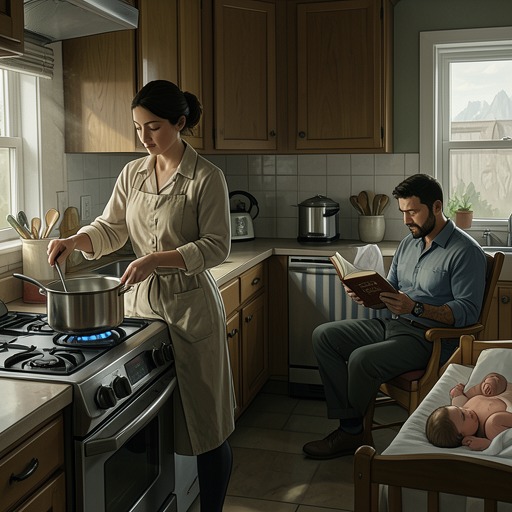
The novel places Timbre’s economic struggle beside Hayden Devillier’s responsibilities as a single father. Hayden cannot simply pursue romance whenever he wants because Crew’s schedule and needs come first. He worries about bringing Crew to the Powell household on weeknights unless necessary, even though Ryan Powell and Peri Powell assure him that Crew is always welcome. This contrast clarifies that financial and domestic stability are collective achievements: the ability to work, date, study, eat, and raise children depends on who can share space, food, supervision, and emotional labor.
The same principle appears when Crew later learns the circumstances of his birth. Ryan Powell explains that Hayden Devillier moved into the hospital room with Krissy Thompson, fed Crew every bottle, changed every diaper, and rocked him when he cried, before bringing him into a household where Hayden, Ryan, and Peri learned to parent him together. The account gives economic hardship a family dimension: care is not only a private feeling but a sustained practice distributed across adults. Hayden’s later willingness to help Timbre is consistent with this established pattern of treating survival as something a family can organize collectively.
Financial hardship consequently becomes a test of relationships rather than a measure of personal worth. Timbre begins by defending herself against unwanted money, works punishing hours, saves for shoes and housing, and hides the shelter because she fears being reduced to her circumstances. Yet the story gradually shows that accepting a job recommendation, a meal, a ride, or a place to live need not cancel self-respect. Recovery comes through a combination of Timbre’s labor and other people’s resources, making interdependence—not isolated self-reliance—the practical answer to an economic crisis.